
Wurkbook Technologies
on 3 months ago
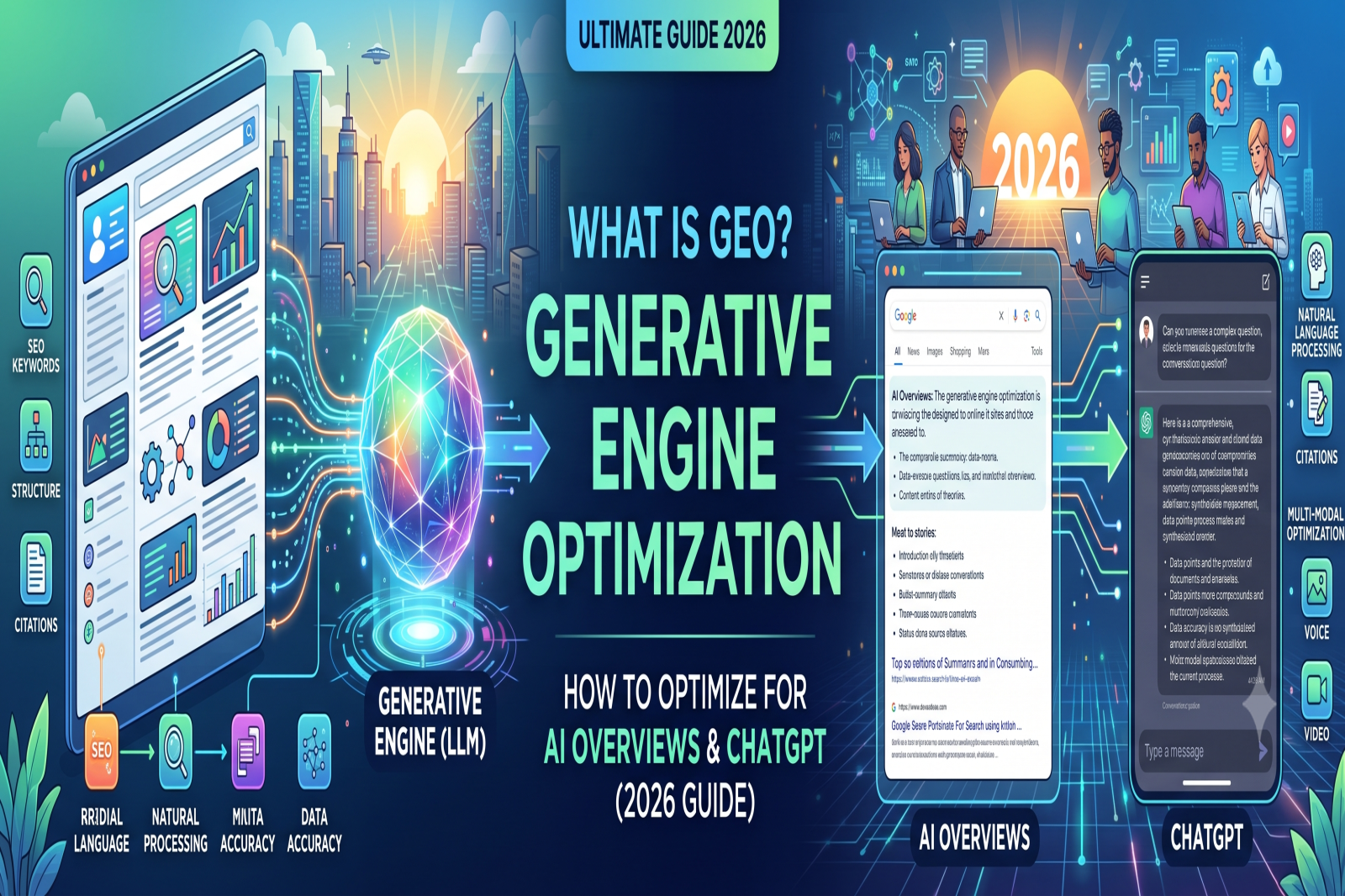
What Is GEO? How to Optimize for AI Overviews & ChatGPT (2026 Guide)
What Is GEO (Generative Engine Optimization)? The Complete Guide to Getting Cited by ChatGPT and AI Overviews
Search isn't just a list of blue links anymore. Type a question into Google today and there's a good chance an AI Overview answers it before you ever see a website. Ask ChatGPT or Perplexity the same question, and you get a synthesized answer with sources baked in — no clicking required.
This shift has a name: Generative Engine Optimization (GEO), also called AI Engine Optimization or Answer Engine Optimization (AEO). If you've noticed your rankings holding steady while your traffic quietly drops, GEO is probably why — and this guide will show you exactly what it is and how to optimize for it.
What Is GEO (Generative Engine Optimization)?
GEO is the practice of structuring and writing content so AI systems — ChatGPT, Google AI Overviews, Perplexity, Gemini, and Claude — can easily understand, trust, and cite it in their generated answers.
Traditional SEO optimizes for ranking algorithms that sort pages into a list. GEO optimizes for language models that read your page, extract the relevant facts, and weave them into a conversational answer — often without sending the reader to your site at all. The goal shifts from "rank in the top 10" to "become the source the AI quotes."
The good news: GEO isn't a different discipline you need to learn from scratch. It builds on the same foundation as good SEO — clear structure, real expertise, and genuinely helpful content — just applied with AI extraction in mind.
GEO vs. SEO: What's Actually Different
| Traditional SEO | GEO | |
|---|---|---|
| Goal | Rank in a list of links | Get quoted in a generated answer |
| Unit of optimization | The whole page | The paragraph or section |
| Key signals | Backlinks, keywords, technical performance | Clear structure, citable facts, consensus across the web |
| Success metric | Rankings, clicks | Citation frequency, brand mentions, AI-referred traffic |
Why GEO Matters Right Now
The numbers explain the urgency better than any trend report:
- B2B buyers are heavily relying on generative AI during their purchasing journey, with many starting their research in ChatGPT-style tools instead of Google.
- Searches that trigger an AI Overview see dramatically less click-through to websites — but brands that do get cited within those AI Overviews see a meaningful lift in both organic and paid clicks.
- Answer-engine-optimized websites are seeing noticeably more branded search traffic as a direct result of being mentioned in AI answers.
The pattern across the data is consistent: showing up in AI answers doesn't just preserve visibility — it tends to drive higher-intent traffic than a traditional ranking ever did, even though raw click volume is down. Ranking #1 on Google no longer guarantees visibility if your content isn't structured for AI extraction — and the inverse is also increasingly true, which is exactly why this matters for anyone running a content strategy right now.
How AI Search Engines Actually Choose What to Cite
Before optimizing, it helps to understand the mechanism. AI answer engines don't rank pages — they retrieve and extract. That means they evaluate content very differently depending on the platform:
- ChatGPT leans on structured, established sources and tends to favor pages with predictable, well-organized formatting — headings, lists, and clear definitions are heavily rewarded.
- Perplexity weights recency and community discussion heavily, often pulling from forums and recently published or updated content over older brand-owned pages.
- Google AI Overviews pulls primarily from content that already ranks well organically — so traditional SEO fundamentals still matter as a prerequisite here.
- Gemini behaves similarly to AI Overviews, leaning on what already performs in standard Google search.
The practical takeaway: there's no single "GEO algorithm." You're optimizing for several extraction systems simultaneously, but they share enough common ground that one well-structured piece of content can perform across all of them.
How to Optimize for AI Overviews and ChatGPT: A Step-by-Step Framework
1. Lead With a Direct Answer (the "Answer Capsule")
Every section should open with a clean, self-contained answer to the question implied by its heading — one to two sentences, no hedging, no fluff. AI models pull these capsules almost verbatim, which is why pages built this way are consistently among the most-cited.
A useful pattern: state the definition or answer first, then explain the reasoning or nuance afterward. Avoid stuffing links into that opening sentence — a clean, link-free answer reads as a self-contained unit of knowledge that's easier for a model to lift directly.
2. Use Question-Based Headings
Skip vague headers like "Overview" or "Getting Started." Instead, phrase headings the way people actually ask questions: "How do I optimize for AI Overviews?" or "What's the difference between GEO and SEO?" When a user's prompt closely matches your heading, your section becomes a strong extraction candidate.
3. Write Short, Single-Idea Paragraphs
AI systems tend to extract at the paragraph level, not the page level. Aim for two to four sentences per paragraph, each covering exactly one idea. Dense, multi-topic paragraphs are harder to lift cleanly, so they get skipped in favor of competitors' tighter writing.
4. Back Every Claim With Specific Data
Vague claims like "many businesses are adopting AI" give a model nothing to cite. Specific, sourced statistics do. Whenever possible, attach a number, a study, or a named source to your claims — and where you can, include original data or research your competitors can't replicate. Unique data points are one of the strongest citation magnets available.
5. Format for Extraction
Numbered steps, bullet lists, comparison tables, and FAQ blocks all give AI models clean, structured chunks to quote. A numbered list lets a model confidently reference "step 3" rather than trying to interpret a paragraph of prose. If you take nothing else from this guide, restructure your high-priority pages into scannable, list-and-table-driven formats.
6. Add Structured Data Markup
Schema.org markup (via JSON-LD) — particularly FAQPage, HowTo, and Article with author fields — doesn't directly cause citations, but it removes ambiguity. It tells crawlers exactly what type of content they're looking at, who wrote it, and how it's organized, which makes an already-relevant page easier to select with confidence.
7. Keep Content Fresh
Pages that go unrefreshed for an extended stretch lose citation share noticeably faster than pages updated regularly — this is especially true for Perplexity, which leans toward recently published or updated material. Display a visible "last updated" date, and revisit your highest-priority pages at least quarterly, even if the update is minor.
8. Build Consensus Across the Web
AI platforms rarely trust a single source in isolation — they look for agreement across multiple independent mentions before citing confidently. If your brand or expertise shows up consistently across your own site, review platforms, industry publications, and relevant community discussions, AI systems gain confidence recommending you. A page that only exists on your own domain, with no outside validation, is a much harder sell.
9. Build Topical Depth, Not Just Single Pages
A site with many interconnected pieces on a topic builds the kind of topical authority a single standalone article can't achieve alone. If you're targeting a competitive topic, plan a cluster of related pages rather than one isolated post.
How to Track Whether GEO Is Working
Unlike traditional rank tracking, GEO measurement is still manual in most organizations, but it's straightforward to start:
- Build a prompt list. Write 15–20 real questions your target customers would ask an AI assistant.
- Query each platform manually. Run those prompts through ChatGPT, Perplexity, Gemini, and Google AI Overviews.
- Log the results. Track whether you're cited, merely mentioned, or absent — and note which competitors show up instead.
- Re-test after changes. Give updates a few weeks to be picked up, then re-run the same prompts and compare.
- Watch branded search volume. A rise in direct searches for your brand name in Google Search Console is often a downstream signal that AI tools are mentioning you, even without a clickable citation.
GEO isn't a replacement for SEO — it's SEO's next layer. The brands winning in AI search are the ones writing clear, well-structured, genuinely useful content with real expertise behind it, then packaging it in a way machines can extract as easily as humans can read it. Start with your highest-traffic, highest-intent pages: add answer capsules, fix your headings, tighten your paragraphs, and back your claims with real data. Everything else builds from there.



POST COMMENT
For post a new comment. You need to login first. Login
COMMENTS(0)
No Comment yet. Be the first